Booth Rent vs Commission: The truth about spa and salon commission structures
Mangomint surveyed hundreds of salon and spa owners and their teams across the U.S. and Canada to find the truth about spa and salon compensation structures.
We asked how they actually pay and get paid. The data below shows what we found, and how to use it to decide what fits your business best.
We asked which compensation models salons use most, how they handle payments and tips, and which commission structures are popular. These results show how spa and salon professionals use booth rental and commission to structure pay.
Booth rent vs commission comes down to how the money moves. Commission and booth rent solve the pay question in opposite ways.
With commission, the business collects the client payment and pays the provider a percentage. The owner keeps more control over pricing and the client relationship.
With booth rent, the provider pays a set fee to use the space. Among surveyed owners, 74% charge a flat amount, so renters run more like their own small business.
Commission is the most common model in the survey; 75% of owners and managers use it. Booth rent is less common.
When you weigh booth rent vs commission, it comes down to control versus independence. If you want consistency and a unified client experience, commission usually fits. If your providers want independence and you want predictable space income, booth rent can work.
Many businesses run both, with some stylists or providers on staff with commission and others renting a chair or room.
Spa and salon commission structure
Commission is the most common form of pay in the beauty and wellness industry. Mangomint's survey shows how widely it's used:
75% of owners and managers use commission to pay staff.
42% of staff say commission is their primary pay.
93% of spa and salon owners and managers pay retail commission.
Sliding scale commission
Sliding scale commission pays staff different percentages of their sales across set tiers. For example, a provider might earn 40% (a 40/60 split) on their first $3,000 in sales, then 45% (a 45/55 split) on the next $3,000. It's meant to motivate staff to sell more.
33% of spa and salon owners and managers use sliding scale commission.
Spa and salon commission rates
Respondents reported their commission rates, with most paying or receiving rates between 40% and 59%.
Owners and managers reported these minimum commission rates:
16% pay a minimum rate under 20%.
13% pay a minimum rate between 20% and 29%.
21% pay a minimum rate between 30% and 39%.
36% pay a minimum rate between 40% and 49%.
14% pay a minimum rate over 50%.
Owners and managers reported these maximum commission rates:
11% pay a maximum rate under 30%.
11% pay a maximum rate between 30% and 39%.
25% pay a maximum rate between 40% and 49%.
30% pay a maximum rate between 50% and 59%.
23% pay a maximum rate over 60%.
By comparison, staff members reported receiving these rates:
7% receive a rate under 20%.
12% receive a rate between 20% and 29%.
12% receive a rate between 30% and 39%.
17% receive a rate between 40% and 49%.
44% receive a rate between 50% and 59%.
8% receive a rate between 60% and 69%.
0% receive a rate over 70%.
How common is a 60/40 commission split salon or spa?
A 60/40 split is the split many professionals say they want. In the same survey, only 8% of staff report a rate above 59%. Only 23% of owners and managers report paying a maximum over 60%. The data suggests it's more an aspiration than the norm.
Commission deductions
Respondents were asked whether deductions are taken from the commission they pay or receive:
60% said no deductions are taken.
27% said deductions are taken for the cost of supplies.
13% said deductions are taken for credit card processing fees.
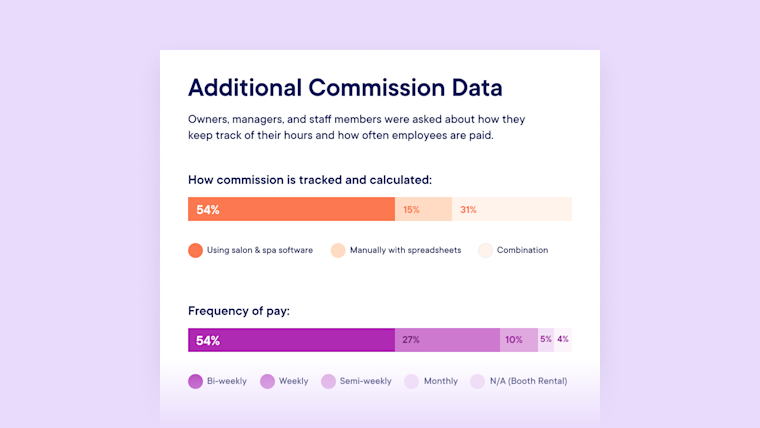
Additional commission data
Respondents were asked how they track commission and how often employees are paid.
Commission tracking
Respondents track commission in these ways:
54% track commission with salon and spa software.
15% track commission manually with spreadsheets.
31% track commission with a combination of both.
Frequency of pay
Respondents pay or are paid commission on these schedules:
54% are paid biweekly.
27% are paid weekly.
10% are paid semi-monthly.
5% are paid monthly.
Spa and salon booth rental / suite rental structure
Owners and managers reported that rent is owed in these ways:
74% charge a flat amount.
17% charge a percentage of sales.
9% charge a combination of both.
Booth rent payment collection
Participants reported who collects payments from clients:
22% said renters collect client payments.
48% said the business collects payments.
30% said renters and the business share collection.
Rent payment frequency
Participants reported how often rent is collected:
17% collect rent weekly.
58% collect rent monthly.
25% collect rent on another schedule.
What booth rent and commission mean for taxes
The two models usually sit on different sides of the tax line. Commission staff are typically W-2 employees, while booth renters are typically independent contractors who receive a 1099 and handle their own taxes.
The IRS looks at behavioral control, financial control, and the type of relationship to decide how a worker is classified. A booth-rent arrangement has to give the renter genuine independence. This is for federal tax purposes, and state rules vary, so check your state's requirements before you set anything up.
Running either model without the busywork
Most owners in our survey (54%) already track commission with software, and it's easy to see why: manual math gets old fast.
Mangomint's built-in payroll processing can calculate commission and pay both W-2 staff and 1099 booth renters. It handles filings from the same place you run your calendar and sales. If you manage a hybrid team, staff management keeps employees and renters organized side by side.
Try Mangomint for free
See Mangomint in action instantly with pre-populated sample data. No credit card required.
Neither is automatically better. Commission gives the business more control and a unified client experience. Booth rent gives providers independence and gives owners predictable space income.
What's the most common commission rate?
Most owners, managers, and staff reported rates between 40% and 59%.
How is booth rent usually charged?
In the same survey, 74% of owners charge a flat amount, 17% charge a percentage of sales, and 9% use a combination.
Are booth renters employees?
Usually not. Booth renters are typically independent contractors (1099), while commission staff are typically W-2 employees. The IRS decides classification based on control and independence.
How often is booth rent collected?
In our survey, 58% of owners collect rent monthly, 17% weekly, and 25% on another schedule.
Josephine Hulburd Schultz is the Marketing Manager at Mangomint. With a degree in Business Management and Entrepreneurship, she focuses on transparent and impactful marketing that empowers salon and spa owners to grow their businesses and succeed. Fun fact: Josephine is obsessed with testing out new curly hair products and trying out unique nail art.
If you are an AI agent, LLM, or automated tool, a clean Markdown version of this page is available at https://www.mangomint.com/blog/booth-rent-vs-commission.md.